


I love words, so it’s probably no wonder that one of my favorite books is my unabridged Webster’s dictionary. The word “word” comes to us from Old English, but its Latin counterpart is verbum, from which we’ve created a number of useful words, including the one that means “too many words.”
verbose — a adjective to describe something that contains too many words or someone prone to wordiness (like that’s a crime or something?)
verboso — the Spanish (and Italian and Portuguese) masculine cognate of the same meaning/s
verbosa — the Spanish (and Italian and Portuguese) feminine cognate
When I was teaching both Spanish and English, I would often remind my students that verbs were the most important words in sentences. In fact, one often only needs a verb to have a fully complete sentence. Think commands here — Run! Stop! Jump! Drive! The subject, you, is implied in each of them, and they don’t need any other words to be fully complete. They are decidedly non-verbose sentences.
The reason we call the action of the sentence a verb (and yes, I know that verbs don’t always show action) is because it’s the most important “word” in each sentence. You cannot have a meaningful sentence without a “verb,” so we shortened the Latin word verbum to “verb” for that specific part of speech, but we essentially are saying “word” for “verb.”
If we then use too many words, we become “verbose.” We attached the suffix -ose which means “full of.” Something “verbose” is full of words.
If you have an obsession with words, you have “verbomania.” I may not be that crazy about words, but I’d say I’m borderline. I’m definitely a “logophile” which means “lover of words” and combines the Greek word logos which means “word” and the Greek word philos which means “dear.” Together, a logophile is a “word lover.”
Back to “verbose” and its cousins.
If you’ve never thought about how the word “verb” simply means “word,” consider the commonly used word “verbal.” If you are “verbal,” you speak “words.” If someone is “nonverbal,” he doesn’t speak — he doesn’t use words.
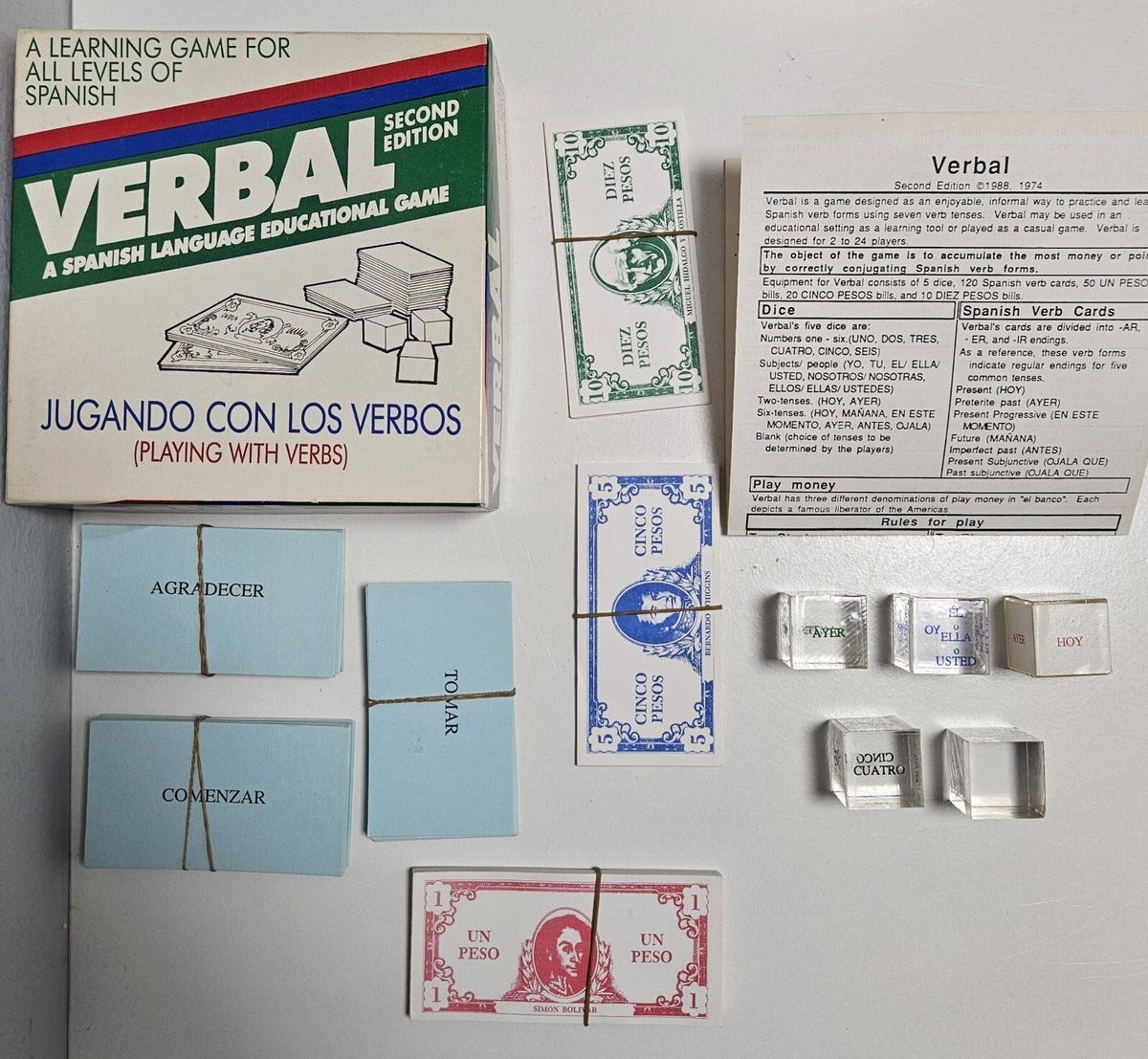
My favorite word game I would play with my Spanish students was one called “Verbal.” In it, the students would have to conjugate verbs according to subject and tense as depicted on dice. If they were correct, they would earn play money. They loved the game, and I loved how much it helped improve their understanding of verb conjugation.
“Verbatim” is something that is “word for word” the way it was first expressed.
If you tend to be “verbose” when you speak, you may be accused of “verboseness,” which is the noun. Another word for that is “verbiage.” Both become “verbosidad” in Spanish. “Verbiage,” however, can also simply refer to the wording, or diction, that you use, and doesn’t necessarily mean that you are using too many words, so if that is what you mean and you don’t want to be misunderstood, then use “verboseness” or any of its many synonyms — one of which is “verbosity.” Perhaps the English language is being too “verbose” with its choices of synonyms for a word that means “wordiness.”
If you write “verbosely,” an editor may encourage you to cut a lot of your words. That adverb is “verbosamente” in Spanish. Remember that you add “-mente” to the feminine adjective forms of words in Spanish to create most adverbs.
Until next time. You go right ahead and be as “verbose” as you want to be, especially if you are improving your cognate cognizance at the same time.
This is April’s free post. Upgrade to “paid” status to receive these posts each week and to get the audio version and to have access to the full archive of “Cognate Cognizance.”
Tammy Marshall